Understanding 10 Percent: From Simple Math to Stunning 3D Rendered Text
The concept of 10 percent is one of the most fundamental building blocks of mathematics, yet its application extends far beyond simple arithmetic. In the digital age, this basic fraction has taken on a new visual life through 3D rendered text, transforming a static number into a dynamic design element. Whether you are calculating a tip at a restaurant, analyzing business growth, or designing a modern website header, understanding the dual nature of "10 percent" as both a mathematical tool and a visual asset is incredibly valuable.
This article explores the significance of 10 percent in everyday life and examines how designers use 3D rendering to make this concept visually striking. By bridging the gap between numerical literacy and digital creativity, we can appreciate how this simple figure influences our decisions and our aesthetics.
The Mathematical Foundation: Why 10 Percent Matters
At its core, 10 percent represents one-tenth of a whole. In decimal form, it is written as 0.1, and as a fraction, it is 1/10. This simplicity is precisely what makes it so powerful. Humans are naturally adept at working with base-10 systems, making 10 percent the easiest percentage to calculate mentally.
To find 10 percent of any number, you simply move the decimal point one place to the left. For example:
- 10 percent of 500 is 50.
- 10 percent of 25 is 2.5.
- 10 percent of 1,000 is 100.
This ease of calculation makes it a cornerstone of financial literacy. When shopping, knowing how to quickly derive 10 percent allows consumers to estimate discounts, sales tax, and tips without needing a calculator. It serves as a mental anchor; once you know 10 percent, you can easily derive other percentages. For instance, if you know that 10 percent of $80 is $8, you can quickly determine that 20 percent is $16 (by doubling) and 5 percent is $4 (by halving).
Practical Applications in Daily Life
The utility of 10 percent permeates various aspects of daily routine and professional work:
- Financial Planning: Many financial advisors recommend saving at least 10 percent of your income. This "pay yourself first" strategy is a foundational rule for building long-term wealth.
- Business Metrics: In corporate settings, a 10 percent increase in revenue or a 10 percent reduction in costs can significantly impact the bottom line. Managers often use this benchmark for setting realistic quarterly goals.
- Education: Teachers frequently use 10 percent as an introductory concept when teaching fractions, decimals, and percentages, helping students build confidence in math.
Understanding these practical applications helps demystify numbers. Instead of viewing percentages as abstract concepts, readers can see them as tools for better decision-making.
The Visual Evolution: 3D Rendered Text
While the mathematical side of 10 percent is about logic and precision, the visual representation—specifically 3D rendered text—is about emotion, depth, and engagement. In graphic design and digital marketing, flat text often fails to capture attention in a crowded digital landscape. This is where 3D rendering comes into play.
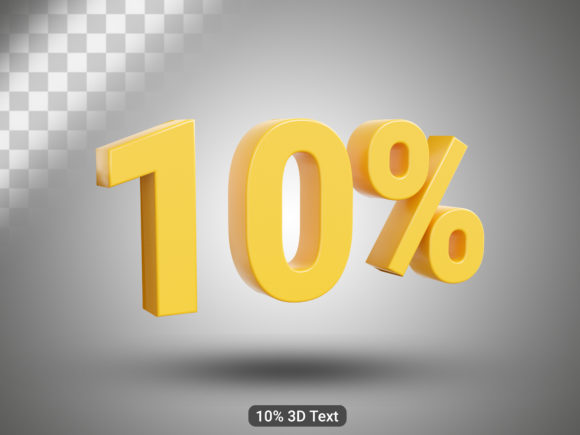
3D rendered text involves creating typography that appears to have volume, depth, and physical presence. Unlike standard 2D fonts, which exist on a single plane, 3D text simulates light, shadow, texture, and perspective. When a designer creates the phrase "10 Percent" in 3D, they are not just typing characters; they are sculpting digital objects.
How 3D Rendering Works
Creating 3D text requires specialized software such as Blender, Cinema 4D, or Adobe Dimension. The process generally involves several key steps:
- Modeling: The text is created as a 3D mesh, giving it thickness and geometry.
- Texturing: Materials are applied to the surface. This could look like polished metal, matte plastic, glowing neon, or rough stone.
- Lighting: Virtual lights are placed around the text to create highlights and shadows, which define its shape and mood.
- Rendering: The computer calculates how light interacts with the 3D model to produce a final 2D image or animation.
When applied to the phrase "10 Percent," these techniques can emphasize the importance of the message. A bold, metallic "10%" might suggest strength and solidity in a financial report, while a soft, pastel-colored 3D render might feel more approachable and friendly for a lifestyle blog.
Bridging Logic and Creativity
The intersection of mathematical clarity and visual appeal is where modern communication thrives. Consider a marketing campaign for a store-wide sale. A plain text advertisement stating "10 Percent Off" is informative but easily overlooked. However, a 3D rendered image of the number "10" bursting out of the screen with vibrant colors and dynamic lighting creates a sense of excitement and urgency.
This synergy is particularly relevant in:
Digital Marketing: Social media platforms favor visually engaging content. 3D text stands out in feeds, increasing click-through rates and user engagement.
Educational Content: Explainer videos often use 3D animations to visualize data. Seeing a 3D bar graph grow by 10 percent helps viewers grasp the scale of change more intuitively than reading a static table.
Web Design: Modern websites often incorporate 3D elements to create immersive experiences. A hero section featuring 3D typography can immediately convey brand personality and professionalism.
Common Misconceptions About 3D Text
Despite its growing popularity, there are misunderstandings about using 3D rendered text. Some beginners assume it is overly complex or reserved only for high-end productions. In reality, user-friendly tools have made 3D design accessible to non-experts. Another misconception is that 3D text is always distracting. When used correctly, it enhances readability and hierarchy rather than detracting from it. The key is balance: the 3D effect should support the message, not overwhelm it.
Best Practices for Using 10 Percent in Design and Data
Whether you are presenting data or designing a graphic, here are some guidelines to ensure your use of "10 percent" is effective:
- Context is King: Ensure the visual style matches the tone. A serious financial document may require subtle, clean 3D effects, while a gaming promo can go wild with neon and explosions.
- Readability First: No matter how stunning the 3D render, the text must be legible. Avoid excessive distortion or low-contrast color combinations.
- Accuracy Matters: If you are visualizing data, ensure the 3D representation accurately reflects the 10 percent figure. Misleading visuals can erode trust.
- Optimize for Performance: 3D images can be large files. Compress them appropriately for web use to maintain fast loading speeds.
By adhering to these principles, creators can leverage the power of 3D text to communicate the significance of 10 percent effectively.
Conclusion
The phrase "10 percent" is more than just a number; it is a versatile concept that bridges the logical world of mathematics and the creative realm of digital design. From helping us manage our finances to catching our eye in a social media ad, its influence is widespread. Understanding how to calculate it empowers us intellectually, while appreciating how it can be rendered in 3D enriches our visual culture.
As technology continues to evolve, the line between data and design will blur further. We will see more interactive 3D visualizations that allow users to manipulate percentages in real-time, offering deeper insights into everything from personal budgets to global economic trends. By mastering both the math and the medium, we become better communicators, smarter consumers, and more creative thinkers.
Whether you are a student learning the basics of percentages, a business owner analyzing growth metrics, or a designer crafting the next viral graphic, remember that 10 percent is a small fraction with a massive impact. Embrace its simplicity in calculation and its potential in visualization to unlock new opportunities in your personal and professional life.